Depwire is the context and safety layer for AI-generated code.
14 CLI commands. 24 MCP tools. 13 auto-generated documents. What If simulation. Pre-action verification. Security scanner. Structural diff. Architecture health scoring. Multi-agent coordination.
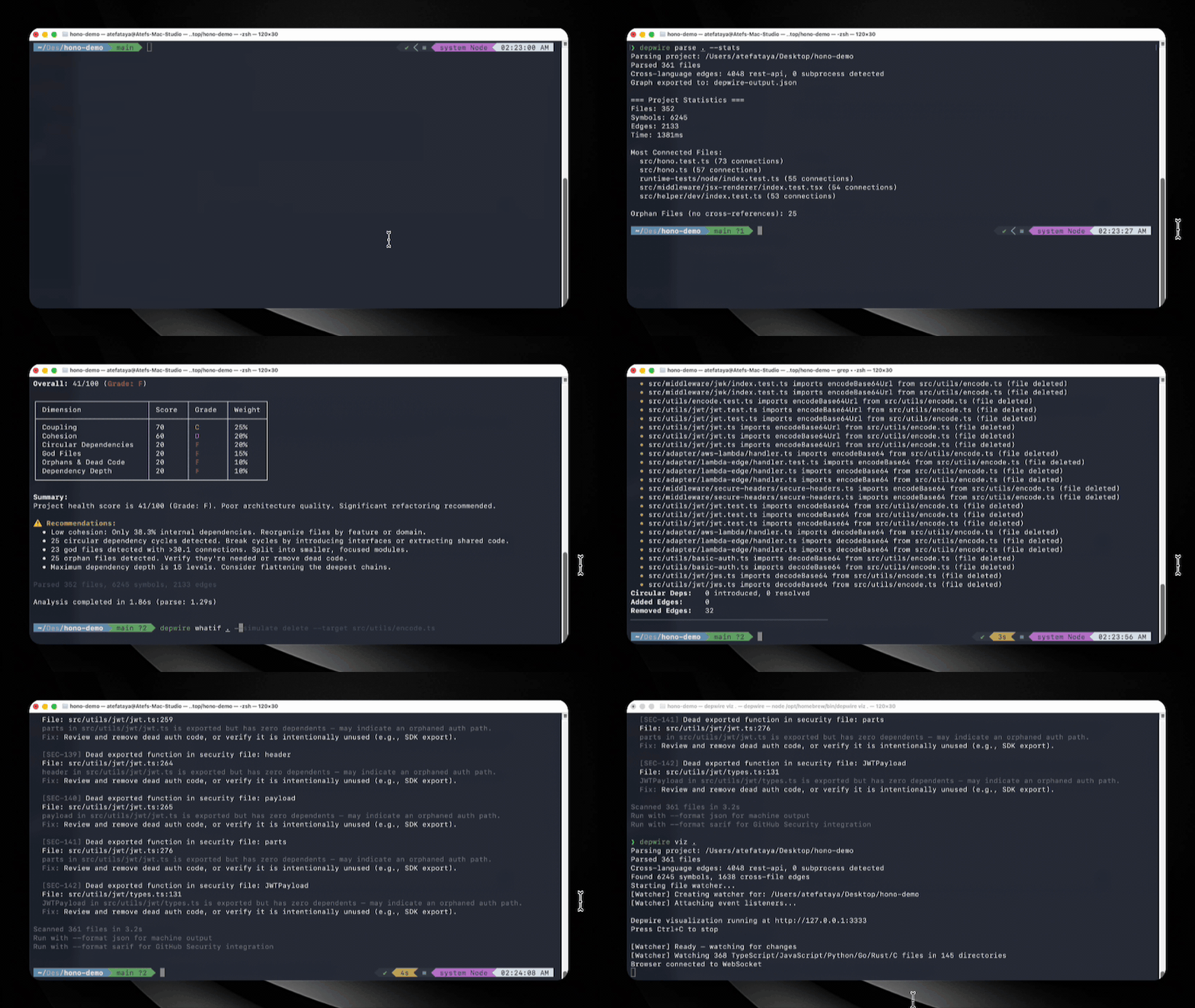
honojs/hono — 352 files, 6,245 symbols, 2,133 edges, 4,048 cross-language edges detected in 1.2s
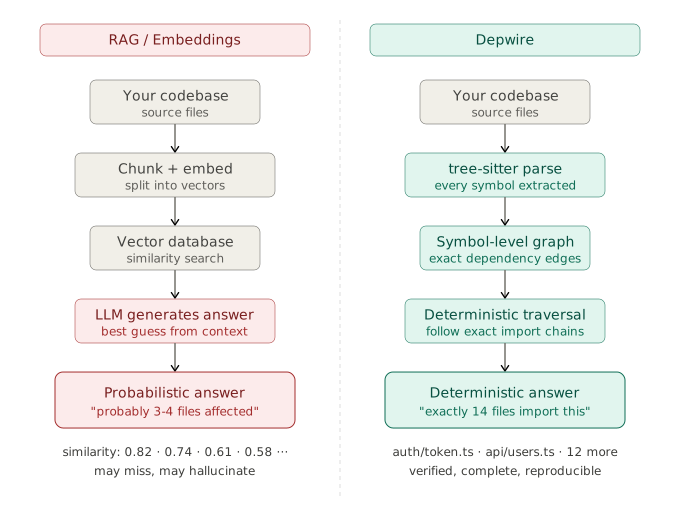
This is not RAG.
No embeddings. No similarity scores. No guesses. 16 programming languages — TypeScript, JavaScript, Python, Go, Rust, C, C#, Java, C++, Kotlin, PHP, Swift, Mojo, Ruby, Dart, and R — plus Angular templates. Parsing uses tree-sitter and pattern-based parsers. Results cover supported constructs and recorded relationships, not every relationship in an arbitrary codebase.
Depwire Action Token — cryptographic audit trails for AI agents
Depwire is the steward of the Depwire Action Token (DAT) specification — an open standard for cryptographically signing AI agent actions. Released under CC0 public domain in May 2026, DAT defines three JWT-based token types that chain together to form a verifiable audit trail for every action an AI agent takes — who authorized it, what model ran it, what context it had, and what it changed. The spec was drafted in response to NIST's February 2026 concept paper calling for industry-led standards on AI agent identity.
AI tools scan your entire codebase every session. Hundreds of files, thousands of tokens, just to understand what they already knew 5 minutes ago.
Rename a function without knowing every downstream consumer? That's how you ship bugs at 2am. AI tools guess at dependencies — Depwire knows them.
Every new conversation with Claude or Cursor starts from zero. No memory of your architecture, no knowledge of what connects to what. You re-explain your codebase every single time.
Depwire parses your code, builds a dependency graph, and serves it to AI tools via MCP. No more guessing.
tree-sitter extracts supported symbols and references
graphology builds an in-memory dependency graph
AI tools query the graph via MCP for context-aware answers
D3.js renders interactive arc diagrams in your browser
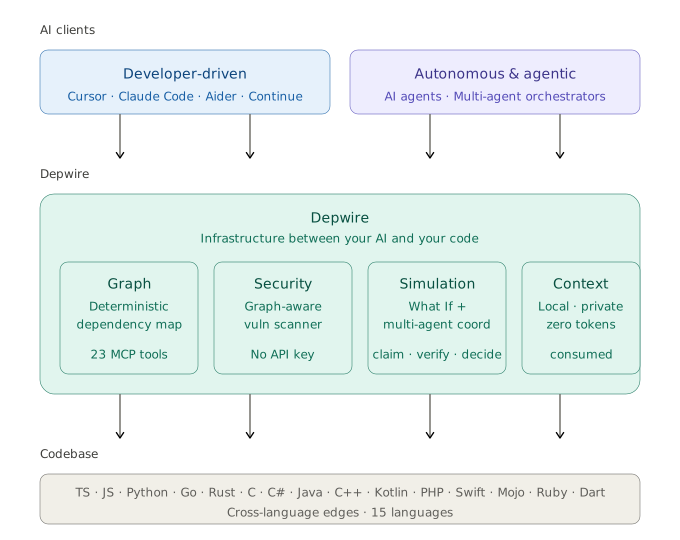
Depwire sits between your AI and your codebase. Every query goes through Depwire — graph context flows back up.

See your entire architecture at a glance. Interactive arc diagrams that make dependencies visible, not hidden in import statements.
24 MCP tools that give Claude, Cursor, and any AI assistant dependency context so your AI isn't working blind.
Renaming a function? Moving a file? Upgrading a dependency? Know the blast radius — the full dependent chain — before you change a single line.
16 programming languages — TypeScript, JavaScript, Python, Go, Rust, C, C#, Java, C++, Kotlin, PHP, Swift, Mojo, Ruby, Dart, and R — plus Angular templates. Parsing uses tree-sitter and pattern-based parsers. Results cover supported constructs and recorded relationships, not every relationship in an arbitrary codebase.
Install with npm install -g depwire-cli. Local CLI analysis requires no Cloud account or separately managed database. Network access can occur for installation, GitHub connections, dependency audits, and browser visualization assets.
Live visualization watches files and rebuilds the graph when they change.
One command generates architecture docs, coding conventions, dependency maps, and onboarding guides — all from your dependency graph. Zero manual writing.
Visualize how your codebase architecture evolved over git history. Scrub through time with an interactive timeline slider.
Find unused symbols before they become technical debt. Confidence-based scoring with smart exclusion rules for entry points, test files, and barrel exports.
find_dead_codeSimulate delete, move, rename, split, merge — see the blast radius, broken imports, and health score delta before your AI makes a single change.
depwire whatifsimulate_changeCLI — Analyze a proposed change with depwire verify-change or the CLI MCP tool verify_change. Reports include potential broken imports, affected files, health movement, and security findings from files on disk. Export-only comparisons and unified diffs return not_comparable for cyclic-group changes and do not certify safety; no build or tests are run.
--fail-on-warningsdepwire verify-changeverify_changeThe security scanner reports findings and can fail a configured CLI gate. Graph-based reachability can raise severity: for example, a medium finding reachable from an MCP-classified entry point becomes high. Entry-point classification uses path heuristics. No Depwire API key is required.
depwire securitysecurity_scanDetects connections between files written in different languages. A TypeScript fetch('/api/users') matched to a Python @app.get('/api/users') route — that's a cross-language edge. Delete the Python route and see the TypeScript callers break.
Compare the dependency graph between any two git commits. See what changed structurally — symbols added, removed, modified, edges created or broken, blast radius, health delta, and security diff. Pure deterministic comparison, no LLM.
depwire diffCoordinate cooperating clients through file claims and decision records. Claims communicate intent; they do not prevent other tools from editing files.
See how your architecture grew, morphed, and evolved across git history.
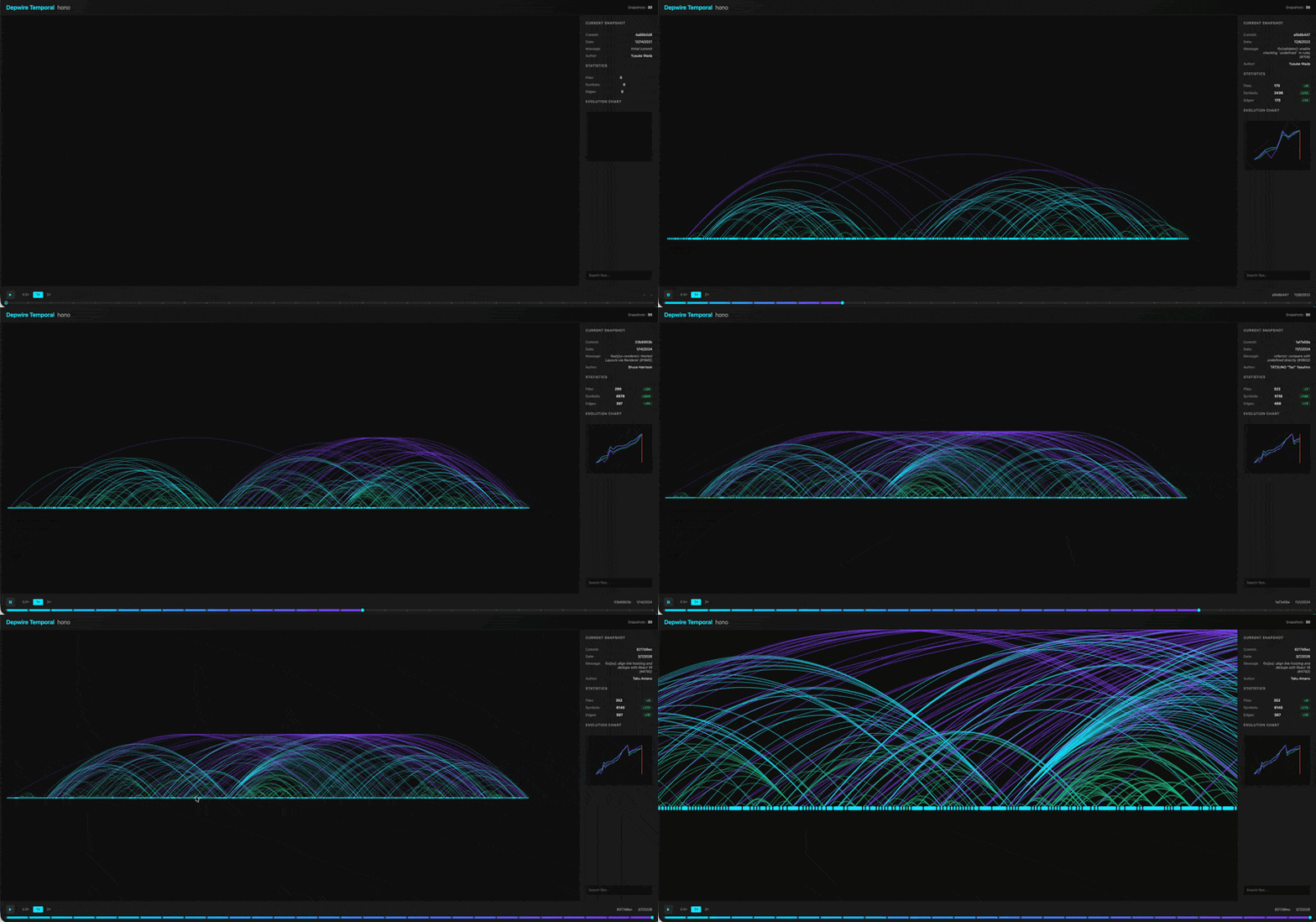
Depwire temporal visualization — Scrub through time, watch arcs morph, see files added and removed
One command. Thirteen documents. Generated from your actual code structure, not guesses.
Module structure, entry points, hub files, layer analysis, and circular dependency detection with suggested fixes.
Naming patterns, import/export style, and design patterns detected automatically from your actual code.
Module dependency matrix, high-impact symbols, longest dependency chains, and tightly coupled file pairs.
Recommended reading order (Foundation → Core → Entry Points), module map, key concepts, and high-impact file warnings.
File catalog with stats, orphan files detection, and hub files that break the most things when changed.
Recorded exported symbols (public API), most-used exports, unused exports, and barrel file analysis.
Error handling patterns, error-prone files, custom error classes, and recommendations for improvement.
Test-file inventory, filename-based test-to-source matching, and files without matched tests. These are structural coverage indicators, not executed test coverage.
Git history + graph analysis: file churn, feature timeline, contributors, and development hotspots.
Codebase snapshot — files, symbols, connections. The reference.
TODO/FIXME/HACK inventory with priority matrix. Shows what's implemented vs pending, prioritized by impact.
Architecture health score report — coupling, cohesion, circular dependencies, god files, orphans, and depth analysis with improvement recommendations.
Unused symbol inventory with confidence classification. High, medium, and low confidence dead code with smart exclusion rules for entry points and test files.
depwire docs --verbose --statsTested on Hono (352 files, 6,072 symbols) — generates all 13 documents in under 0.3 seconds.
Generated documents cover supported constructs and recorded relationships; source-pattern and structural indicators do not establish runtime behavior or implementation completeness.
| Project | Language | Files | Symbols | Time |
|---|---|---|---|---|
| Hono | TypeScript | 352 | 6,245 | 2.3s |
| Excalidraw | TypeScript/React | 320 | — | < 3s |
| FastAPI | Python | 47 | — | < 1s |
| Express | JavaScript | 6 | — | < 1s |
| Cobra | Go | 19 | — | < 1s |
| ASP.NET Docs | C# | 5,655 | 42,827 | 12s |
| Spring PetClinic | Java | 49 | 1,082 | 142ms |
| nlohmann/json | C++ | 480 | 7,119 | 3.71s |
| ktor-samples | Kotlin | 208 | 4,288 | 1.23s |
| WordPress/wp-cli | PHP | ~300 | — | < 2s |
| dart-lang/shelf | Dart | 108 | 1,639 | 0.11s |
| r-lib/httr2 | R | — | — | — |
Zero configuration. Parse failures are counted and reported, never silently dropped.
npm install -g depwire-cliext install depwire.depwire-vscodeOr search Depwire in VSCode Extensions panel. Free to install. Pro features at $9.99/month.
app.depwire.devConnect a GitHub repository to use hosted graph tools through the Cloud MCP endpoint. Setup and parsing time depend on the repository and service availability.
Cloud — verify_change is a heuristic impact report using the existing dependency graph and regex checks on supplied text. It does not apply or reparse changes, run builds, type checks or tests, or verify safety. Potential import impacts assume affected symbols are removed; reported cycles already exist in the loaded graph. Health deltas are estimates. Security checks are regex matches, not a comprehensive audit; unified diffs are scanned including removed lines. Results depend on graph coverage and freshness, and missing or unmatched files can yield no findings. The response includes analysis_mode: existing_graph_heuristic and assessment_under_revision: “The safe/risk_level assessment is a heuristic under active revision; see limitations for details.” safe means only that the heuristic assigned low risk, not a correctness or security guarantee.
Cloud’s /pr-review endpoint has been disabled since 18 Oct 2026 and returns HTTP 503 without analysis or a posted comment.
# Auto-detects project root from current directory
depwire viz
depwire parse
depwire docs
depwire health
depwire whatif
depwire security
depwire verify-change
depwire diff

# Compare dependency graph between two commits
depwire diff main feature/auth-refactor
depwire diff HEAD~5 HEAD --verbose
depwire diff v1.5.0 v1.6.0 --json | jq

# Verify a proposed change before applying it
depwire verify-change --file src/foo.ts --content-from new-version.ts
depwire verify-change --diff feature.patch --fail-on-warnings

# Or specify a directory explicitly
npx depwire-cli viz ./my-project
npx depwire-cli parse ./my-project

# Exclude test files and node_modules
npx depwire-cli parse --exclude "**/*.test.*" "**/node_modules/**"// ~/Library/Application Support/Claude/claude_desktop_config.json
{
"mcpServers": {
"depwire": {
"command": "npx",
"args": ["-y", "depwire-cli", "mcp"]
}
}
}
// Depwire auto-detects your project root. No path configuration needed.Show me the architecture.Depwire isn't just a visualizer. It's a full context engine with 24 tools that AI assistants call autonomously based on your questions.
| Tool | What It Does |
|---|---|
connect_repo |
Connect a permitted local project path or a GitHub repository URL. |
impact_analysis |
What breaks if you change a symbol? |
get_file_context |
Full context — imports, exports, dependents |
get_dependencies |
What does a symbol depend on? |
get_dependents |
What depends on this symbol? |
search_symbols |
Find symbols by name |
get_architecture_summary |
High-level project overview |
list_files |
List all files with stats |
get_symbol_info |
Look up any symbol's details |
visualize_graph |
Generate interactive arc diagram visualization |
get_project_docs |
Retrieve auto-generated codebase documentation |
update_project_docs |
Regenerate documentation on demand |
get_health_score |
Architecture health score across 6 dimensions |
get_temporal_graph |
Visualize how your codebase evolved over git history |
find_dead_code |
Find unused symbols with confidence-based scoring |
simulate_change |
Simulate move, delete, rename, split, or merge operations on a loaded graph. The simulation does not edit source files; loading or parsing the graph requires file I/O. |
security_scan |
Scan for security vulnerabilities with graph-aware severity elevation. No API key required. |
verify_change |
CLI: compare proposed exports and report impact, health movement, and comparison limits. Edited content and unified diffs return not_comparable for cyclic-group safety. Cloud: a separate existing-graph heuristic with assessment_under_revision; see the labelled Cloud disclosure. |
claim_files |
Declare file-editing intent for cooperating clients; claims do not enforce filesystem locks. |
release_files |
Release a previously made file claim. |
get_active_claims |
Query who is currently working on what. |
record_decision |
Save a structured decision for future sessions to reference. |
get_decisions |
Retrieve past decisions by query, session, file, or tag. |
affected_files |
Find files and tests affected by changing a file or symbol. |
Programmatic SDK available via depwire-cli/sdk for cloud and tooling integrations.
See the impact of every PR before you merge
The Depwire GitHub Action runs on configured pull requests and posts an automatic dependency impact report. Know which symbols break, which files are affected, and what the architectural blast radius is — before the code lands.
name: Depwire PR Impact
on:
  pull_request:
    branches: [main]

permissions:
  contents: read
  pull-requests: write

jobs:
  impact:
    runs-on: ubuntu-latest
    steps:
      - uses: actions/checkout@v4
        with:
          fetch-depth: 0
      - uses: actions/setup-node@v4
        with:
          node-version: "20"
      - uses: depwire/depwire-action@v1
        with:
github-token: ${{ secrets.GITHUB_TOKEN }}Semantic search retrieves context by text similarity. Depwire instead uses Tree-sitter to build an inspectable structural map of calls and imports.
| Feature | Depwire | Standard RAG | LLM Native Scanning |
|---|---|---|---|
| Logic | ✓ Deterministic Graph | Probabilistic Match | Brute Force Reading |
| Context source | ✓ Tree-sitter AST relationships | Embedding similarity | Model-selected files |
| Refactor Safety | ✓ Traces full call chains | Misses indirect refs | Zero — blind edits |
| Token Cost | Focused graph queries; token use depends on the client and response size | High — context stuffing | Extreme — scans everything |
| Circular Detection | ✓ Built-in | ✗ Not possible | Occasional |
| What If Simulation | ✓ Before touching code | ✗ | ✗ |
| Architecture Health Score | ✓ 0-100 with dimensions | ✗ | ✗ |
Depwire doesn't replace Claude Code, Cursor, or Aider. It gives them the map they've been missing.
Surgical refactoring with full blast radius awareness before touching anything.
IDE coding with architecture health monitoring and dead code detection.
The Power Couple Stack. Internal codebase structure + external library docs = nothing left to guess.
Terminal-based refactoring with deterministic impact analysis instead of repo map guessing.
Get notified about team features, cloud dashboard, and major releases.
Prefer a browser? app.depwire.dev gives you the full dashboard without local setup.
 Depwire